

암복호화 도구
이 문서의 규격을 직접 시험해볼 수 있는 데스크톱 도구를 제공합니다. 쿼리스트링 암복호화는 물론, API 호출과 웹훅 수신까지 한 곳에서 확인할 수 있습니다.암복호화 테스트 툴 사용 안내
다운로드, 설치, 각 탭 사용법과 문제 해결을 안내합니다.
암호화 옵션
쿼리 스트링 암호화 모듈의 종류
암호화 모듈의 종류
쿼리 스트링 암호화
쿼리 스트링 암호화
안전한 데이터 전송 옵션
안전한 데이터 전송 옵션
암/복호화 방식
암/복호화 방식
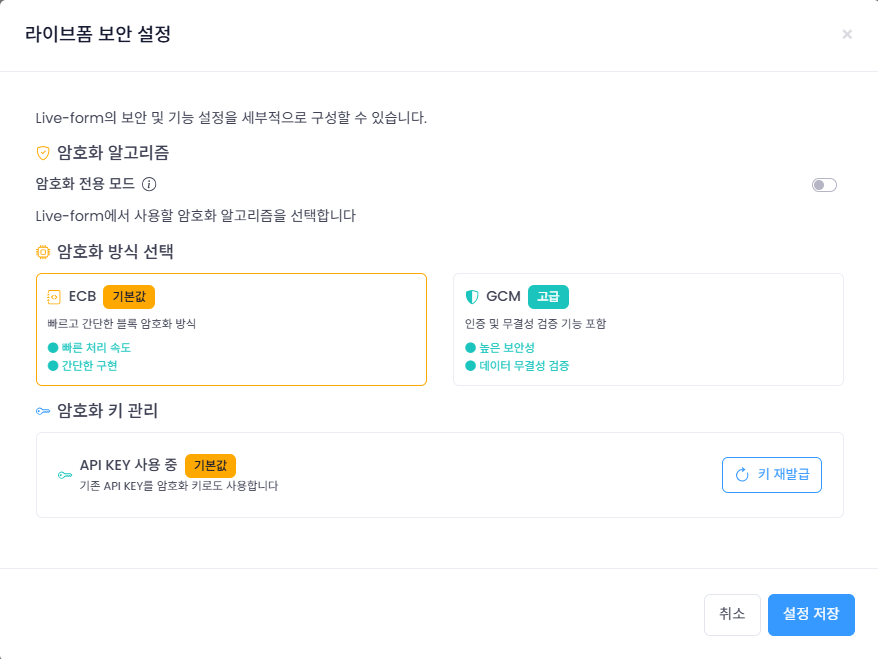
1. 암호화 모듈의 종류
적용 가능한 암호화 모듈의 종류는 다음 두가지 입니다.- AES-256: 빠르고 간단한 블록 암호화 방식
- GCM-256: 인증 및 무결성 기능을 포함한 강화된 암호화 방식
암호화 키 종류
- API 키: Project에 부여된 API 키
- Custom API 키: 라이브폼에서 신규로 발급받아 사용하는 secretKey
2. 쿼리 스트링 암호화
URL의 쿼리 스트링으로 전송되는 민감한 데이터를 AES-256 방식이나 GCM-256 방식으로 암호화합니다.1
암호화할 데이터를 JSON 형식으로 준비
각 Query String 키에 대한 설명은 다음 링크를 참조하세요.주요 QueryString 파라미터
{
    "email": "email@email.com",
    "userid": "userid",
    "cf1": "value 1",
    "cf2": "value 2",
    "cf3": "value 3",
    "blacklistCountries": false,
    "approvePeriod": false,
    "rejectPeriod": false,
    "ageLimit": false,
    "rejectDuplicateUser": true,
    "token": "token_id",
    "allowedCountries": "USA,KOR"
}
{
    "email": "email@email.com",
    "userid": "userid",
    "cf1": "value 1",
    "cf2": "value 2",
    "cf3": "value 3",
    "knowledgeField": "birthDate,gender,nationality,name,SSN,name,address,phoneNumber",
    "knowledgePrefill" : "gender=male,nationality=USA,SSN=123-34-0001,address=Washington D.C.,name=Brown James,birthDate=1980-01-01,phoneNumber=+15555551234",
    "blacklistCountries": false,
    "ageLimit": false,
    "rejectDuplicateUser": true,
    "allowedCountries": "USA"
}
2
암호화 모듈 AES-256/GCM-256 및 API 키 및 secretKey 중 하나를 선택
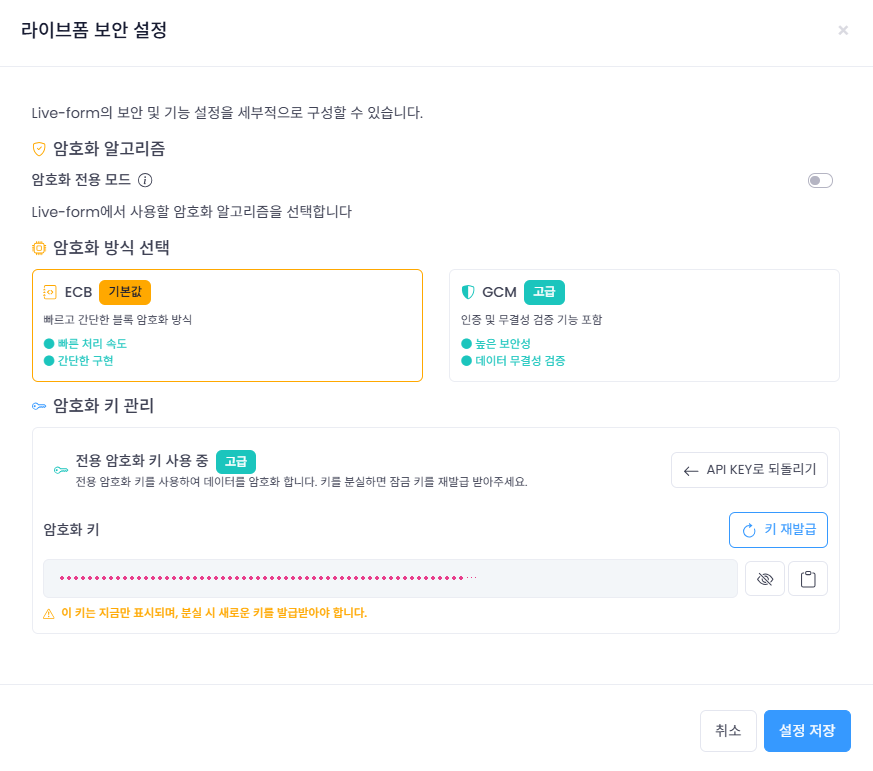
secretKey의 경우 한번 발급 이후 표시되지 않습니다. 분실 시, 재발급해서 사용해주세요.
3
제공된 API 키로 AES-256/GCM-256 암호화 수행
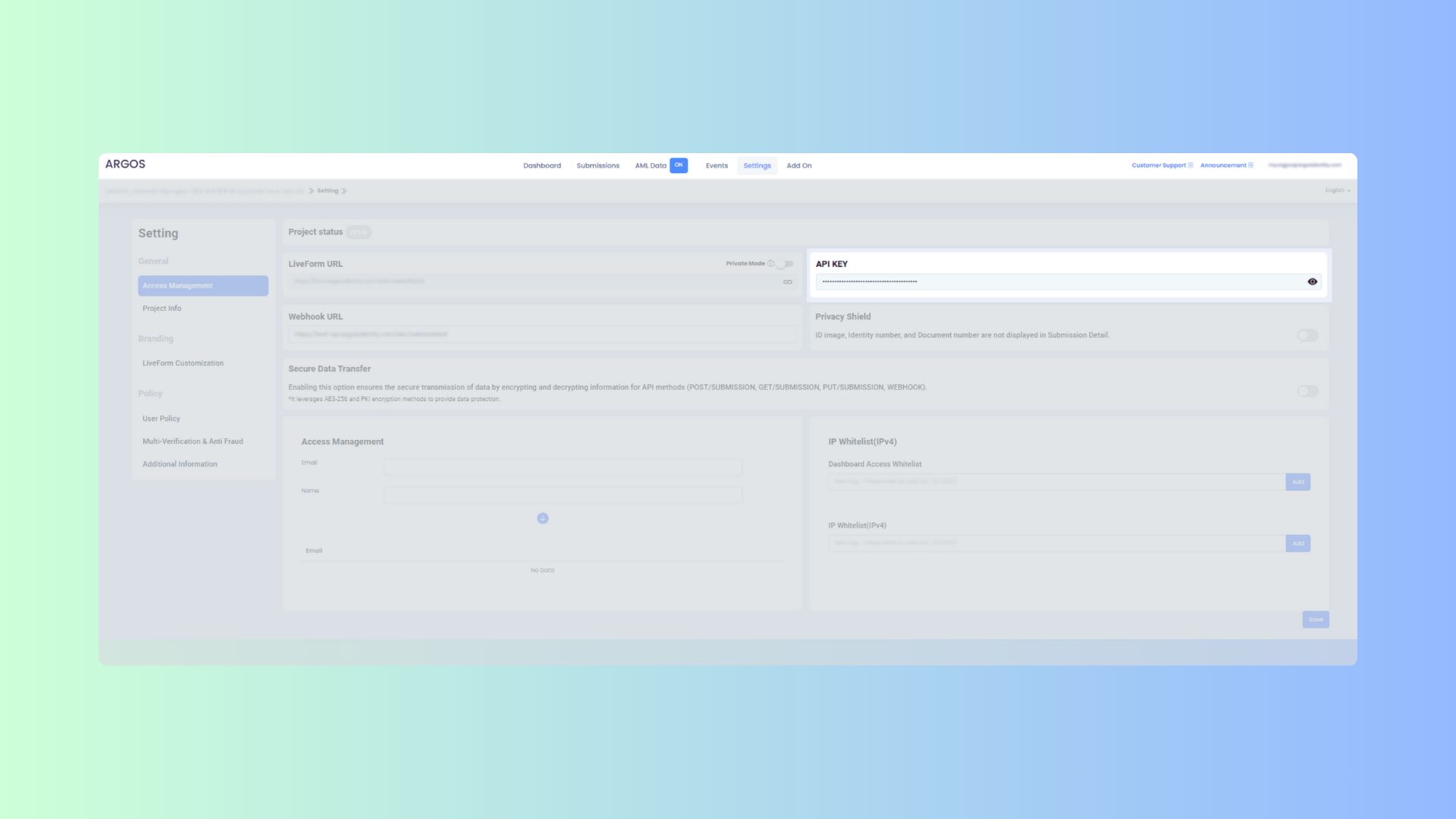
AES-256 암호화 수행 전에 쿼리 스트링 암호화 및 복호화 단계를 확인해주세요.
secretKey를 발급받은 경우, secretKey를 활용해주세요.
secretKey를 발급받은 경우, secretKey를 활용해주세요.
4
암호화된 데이터를 URL의 encrypted 쿼리 파라미터에 추가
https://form.argosidentity.com?pid={project_Id}&encrypted={encrypted_json_text}
이 페이지의 라이브폼 URL은 US 리전 프로젝트 기준입니다. KR 리전 프로젝트는 호스트가
form-kr.argosidentity.com입니다. 자세한 내용은 리전 안내를 참고하세요.주의: pid, lang 쿼리 스트링 및 ‘추가 프로세스 (Injection)’ 페이지에서 사용하는 sid, action 쿼리 스트링은 암호화를 지원하지 않습니다.
3. 쿼리 스트링 암호화 및 복호화 방법
3-1. 키 생성 프로세스
AES-256 GCM-2561
Hashed Key 생성
var crypto = require('crypto');
var hashedKey = crypto.createHash('sha256').update(APIKEY).digest();
const CryptoJS = require('crypto-js');
const hashedKey = CryptoJS.SHA256(APIKEY);
2
암호화 예시
아래 예시는 데이터를 AES-256 방식으로 암호화하는 방법을 보여줍니다.
  var crypto = require('crypto');

  /**
  * @param {string} data - Stringified JSON data
  * @param {string} apiKey - Project API key
  * @returns {string} Encrypted data
  *
  * 정확한 암호화를 위해선 formatJSON 으로 사용해주세요. 예시는 다음과 같습니다.
  * const data = {
      userid: "10912301",
      email: "email@email.com"
  * };
  *
  * 다음과 같이 직접 string 으로 입력을 피해주세요.
  * 기대한 암호화 결과가 달라질 수 있습니다.
  * `{"userid":"10912301","email":"email@email.com"}`
  */

  function encrypt(data, apiKey) {
    var hashedKey = crypto.createHash('sha256').update(apiKey).digest();
    var cipher = crypto.createCipheriv('aes-256-ecb', hashedKey, null);
    return cipher.update(data, 'utf8', 'base64') + cipher.final('base64');
  }
const CryptoJS = require('crypto-js');

const encrypt = (data, apiKey) => {
  const hashedKey = CryptoJS.SHA256(apiKey);
  const encrypted = CryptoJS.AES.encrypt(data, hashedKey, {
    mode: CryptoJS.mode.ECB,
  });
  return encrypted.ciphertext.toString(CryptoJS.enc.Base64);
};
import javax.crypto.Cipher;
import javax.crypto.spec.SecretKeySpec;
import java.nio.charset.StandardCharsets;
import java.security.MessageDigest;
import java.util.Base64;

public class Encryption {
    public static String encrypt(String data, String apiKey) throws Exception {
        // API 키를 SHA-256으로 해시
        MessageDigest digest = MessageDigest.getInstance("SHA-256");
        byte[] hashedKey = digest.digest(apiKey.getBytes(StandardCharsets.UTF_8));

        // AES-256 호환을 위한 32바이트 길이 보장
        byte[] aesCompatibleKey = new byte[32];
        System.arraycopy(hashedKey, 0, aesCompatibleKey, 0, 32);

        // AES 암호화를 위한 키 생성
        SecretKeySpec secretKey = new SecretKeySpec(hashedKey, "AES");

        // AES/ECB/PKCS5Padding 모드로 Cipher 초기화
        Cipher cipher = Cipher.getInstance("AES/ECB/PKCS5Padding");
        cipher.init(Cipher.ENCRYPT_MODE, secretKey);

        // 데이터 암호화
        byte[] encryptedBytes = cipher.doFinal(data.getBytes(StandardCharsets.UTF_8));

        // Base64 인코딩하여 결과 반환
        return Base64.getEncoder().encodeToString(encryptedBytes);
    }
}
3
GCM 암호화 예시
아래 예시는 데이터를 AES-256-GCM 방식으로 암호화하는 방법을 보여줍니다.
var crypto = require('crypto');

/**
 * @param {string} data - Stringified JSON data
 * @param {string} apiKey - Project API key
 * @returns {string} Encrypted data in hex format (IV + ciphertext + tag)
 *
 * GCM 모드는 인증된 암호화를 제공하며, IV와 인증 태그가 포함됩니다.
 * 반환값은 12바이트 IV + 암호문 + 16바이트 인증 태그를 hex 문자열로 인코딩한 형태입니다.
 */
function encryptGCM(data, apiKey) {
    var hashedKey = crypto.createHash('sha256').update(apiKey).digest();
    var iv = crypto.randomBytes(12);
    var cipher = crypto.createCipheriv('aes-256-gcm', hashedKey, iv);

    var encrypted = cipher.update(data, 'utf8');
    encrypted = Buffer.concat([encrypted, cipher.final()]);

    var tag = cipher.getAuthTag();
    var result = Buffer.concat([iv, encrypted, tag]);

    return result.toString('hex');
}

/**
 * @param {string} encryptedHex - Hex encoded encrypted data
 * @param {string} apiKey - Project API key
 * @returns {string} Decrypted data
 */
function decryptGCM(encryptedHex, apiKey) {
    var hashedKey = crypto.createHash('sha256').update(apiKey).digest();
    var encryptedBuffer = Buffer.from(encryptedHex, 'hex');

    var iv = encryptedBuffer.slice(0, 12);
    var tag = encryptedBuffer.slice(-16);
    var encrypted = encryptedBuffer.slice(12, -16);

    var decipher = crypto.createDecipheriv('aes-256-gcm', hashedKey, iv);
    decipher.setAuthTag(tag);

    var decrypted = decipher.update(encrypted);
    decrypted = Buffer.concat([decrypted, decipher.final()]);

    return decrypted.toString('utf8');
}
const CryptoJS = require('crypto-js');

/**
 * @param {string} data - Stringified JSON data
 * @param {string} apiKey - Project API key
 * @returns {string} Encrypted data in hex format
 */
const encryptGCM = (data, apiKey) => {
    const hashedKey = CryptoJS.SHA256(apiKey);
    const iv = CryptoJS.lib.WordArray.random(12);

    // GCM 모드는 crypto-js에서 직접 지원하지 않으므로
    // Node.js crypto 모듈을 사용하는 것을 권장합니다.
    // 아래는 개념적인 예시입니다.

    // 실제 구현시에는 Node.js crypto 모듈 사용을 권장
    throw new Error('GCM 모드는 crypto-js에서 지원하지 않습니다. Node.js crypto 모듈을 사용하세요.');
};

/**
 * @param {string} encryptedHex - Hex encoded encrypted data
 * @param {string} apiKey - Project API key
 * @returns {string} Decrypted data
 */
const decryptGCM = (encryptedHex, apiKey) => {
    // crypto-js는 GCM을 지원하지 않으므로 Node.js crypto 모듈 사용 권장
    throw new Error('GCM 모드는 crypto-js에서 지원하지 않습니다. Node.js crypto 모듈을 사용하세요.');
};
import javax.crypto.Cipher;
import javax.crypto.spec.GCMParameterSpec;
import javax.crypto.spec.SecretKeySpec;
import java.nio.charset.StandardCharsets;
import java.security.MessageDigest;
import java.security.SecureRandom;
import java.util.Base64;
import java.util.HexFormat;

public class GCMEncryption {
    private static final int GCM_IV_LENGTH = 12;
    private static final int GCM_TAG_LENGTH = 16;

    /**
     * @param data - Stringified JSON data
     * @param apiKey - Project API key
     * @return Encrypted data in hex format (IV + ciphertext + tag)
     */
    public static String encryptGCM(String data, String apiKey) throws Exception {
        // API 키를 SHA-256으로 해시
        MessageDigest digest = MessageDigest.getInstance("SHA-256");
        byte[] hashedKey = digest.digest(apiKey.getBytes(StandardCharsets.UTF_8));

        // AES 암호화를 위한 키 생성
        SecretKeySpec secretKey = new SecretKeySpec(hashedKey, "AES");

        // GCM 모드로 Cipher 초기화
        Cipher cipher = Cipher.getInstance("AES/GCM/NoPadding");

        // 12바이트 IV 생성
        byte[] iv = new byte[GCM_IV_LENGTH];
        SecureRandom random = new SecureRandom();
        random.nextBytes(iv);

        // GCM 파라미터 설정 (태그 길이 128비트)
        GCMParameterSpec gcmSpec = new GCMParameterSpec(GCM_TAG_LENGTH * 8, iv);
        cipher.init(Cipher.ENCRYPT_MODE, secretKey, gcmSpec);

        // 데이터 암호화
        byte[] encryptedBytes = cipher.doFinal(data.getBytes(StandardCharsets.UTF_8));

        // IV + 암호문 + 태그를 결합하여 hex로 인코딩
        byte[] result = new byte[iv.length + encryptedBytes.length];
        System.arraycopy(iv, 0, result, 0, iv.length);
        System.arraycopy(encryptedBytes, 0, result, iv.length, encryptedBytes.length);

        return HexFormat.of().formatHex(result);
    }

    /**
     * @param encryptedHex - Hex encoded encrypted data
     * @param apiKey - Project API key
     * @return Decrypted data
     */
    public static String decryptGCM(String encryptedHex, String apiKey) throws Exception {
        // API 키를 SHA-256으로 해시
        MessageDigest digest = MessageDigest.getInstance("SHA-256");
        byte[] hashedKey = digest.digest(apiKey.getBytes(StandardCharsets.UTF_8));

        // AES 복호화를 위한 키 생성
        SecretKeySpec secretKey = new SecretKeySpec(hashedKey, "AES");

        // hex 문자열을 바이트 배열로 변환
        byte[] encryptedData = HexFormat.of().parseHex(encryptedHex);

        // IV와 암호문 분리
        byte[] iv = new byte[GCM_IV_LENGTH];
        byte[] ciphertext = new byte[encryptedData.length - GCM_IV_LENGTH];
        System.arraycopy(encryptedData, 0, iv, 0, GCM_IV_LENGTH);
        System.arraycopy(encryptedData, GCM_IV_LENGTH, ciphertext, 0, ciphertext.length);

        // GCM 모드로 Cipher 초기화
        Cipher cipher = Cipher.getInstance("AES/GCM/NoPadding");
        GCMParameterSpec gcmSpec = new GCMParameterSpec(GCM_TAG_LENGTH * 8, iv);
        cipher.init(Cipher.DECRYPT_MODE, secretKey, gcmSpec);

        // 데이터 복호화
        byte[] decryptedBytes = cipher.doFinal(ciphertext);
        return new String(decryptedBytes, StandardCharsets.UTF_8);
    }
}
import os
import base64
from cryptography.hazmat.primitives import hashes
from cryptography.hazmat.primitives.ciphers.aead import AESGCM

def hashed_key(api_key: str) -> bytes:
    """API 키를 SHA-256으로 해시하여 32바이트 키 생성"""
    digest = hashes.Hash(hashes.SHA256())
    digest.update(api_key.encode("utf-8"))
    return digest.finalize()

def encrypt_gcm(data: str, api_key: str) -> str:
    """
    AES-256-GCM 방식으로 데이터를 암호화합니다.

    Args:
        data: 암호화할 JSON 문자열
        api_key: 프로젝트 API 키

    Returns:
        hex 형식의 암호화된 데이터 (IV + ciphertext + tag)
    """
    key = hashed_key(api_key)
    iv = os.urandom(12)  # 12바이트 IV 생성
    aesgcm = AESGCM(key)

    # 데이터 암호화 (인증 태그 포함)
    ct_tag = aesgcm.encrypt(iv, data.encode("utf-8"), None)

    # IV + 암호문 + 태그를 결합하여 hex로 인코딩
    result = iv + ct_tag
    return result.hex()

def decrypt_gcm(encrypted_hex: str, api_key: str) -> str:
    """
    AES-256-GCM 방식으로 암호화된 데이터를 복호화합니다.

    Args:
        encrypted_hex: hex 형식의 암호화된 데이터
        api_key: 프로젝트 API 키

    Returns:
        복호화된 데이터
    """
    key = hashed_key(api_key)
    encrypted_data = bytes.fromhex(encrypted_hex)

    # IV와 암호문+태그 분리
    iv = encrypted_data[:12]
    ct_tag = encrypted_data[12:]

    aesgcm = AESGCM(key)
    decrypted_data = aesgcm.decrypt(iv, ct_tag, None)
    return decrypted_data.decode("utf-8")
4
복호화 예시
아래 예시는 AES-256 방식으로 암호화된 데이터를 복호화하는 방법을 보여줍니다.
    var crypto = require('crypto');

  /**
  * @param {string} encryptedData
  * @param {string} apiKey
  * @returns {string} Decrypted data
  */
  function decrypt(encryptedData, apiKey) {
    var hashedKey = crypto.createHash('sha256').update(apiKey).digest();
    var decipher = crypto.createDecipheriv('aes-256-ecb', hashedKey, null);
    return decipher.update(encryptedData, 'base64', 'utf8') + decipher.final('utf8');
  }
const CryptoJS = require('crypto-js');

const decrypt = (encryptedData, apiKey) => {
  const hashedKey = CryptoJS.SHA256(apiKey);
  const decrypted = CryptoJS.AES.decrypt(encryptedData, hashedKey, {
    mode: CryptoJS.mode.ECB
  });
  return decrypted.toString(CryptoJS.enc.Utf8);
};
5
GCM 복호화 예시
아래 예시는 AES-256-GCM 방식으로 암호화된 데이터를 복호화하는 방법을 보여줍니다.
var crypto = require('crypto');

/**
 * @param {string} encryptedHex - Hex encoded encrypted data (IV + ciphertext + tag)
 * @param {string} apiKey - Project API key
 * @returns {string} Decrypted data
 */
function decryptGCM(encryptedHex, apiKey) {
    var hashedKey = crypto.createHash('sha256').update(apiKey).digest();
    var encryptedBuffer = Buffer.from(encryptedHex, 'hex');

    // IV, 암호문, 태그 분리
    var iv = encryptedBuffer.slice(0, 12);
    var tag = encryptedBuffer.slice(-16);
    var encrypted = encryptedBuffer.slice(12, -16);

    var decipher = crypto.createDecipheriv('aes-256-gcm', hashedKey, iv);
    decipher.setAuthTag(tag);

    var decrypted = decipher.update(encrypted);
    decrypted = Buffer.concat([decrypted, decipher.final()]);

    return decrypted.toString('utf8');
}
const CryptoJS = require('crypto-js');

/**
 * @param {string} encryptedHex - Hex encoded encrypted data
 * @param {string} apiKey - Project API key
 * @returns {string} Decrypted data
 */
const decryptGCM = (encryptedHex, apiKey) => {
    // crypto-js는 GCM을 지원하지 않으므로 Node.js crypto 모듈 사용 권장
    throw new Error('GCM 모드는 crypto-js에서 지원하지 않습니다. Node.js crypto 모듈을 사용하세요.');
};
import javax.crypto.Cipher;
import javax.crypto.spec.GCMParameterSpec;
import javax.crypto.spec.SecretKeySpec;
import java.nio.charset.StandardCharsets;
import java.security.MessageDigest;
import java.util.HexFormat;

public class GCMDecryption {
    private static final int GCM_IV_LENGTH = 12;
    private static final int GCM_TAG_LENGTH = 16;

    /**
     * @param encryptedHex - Hex encoded encrypted data (IV + ciphertext + tag)
     * @param apiKey - Project API key
     * @return Decrypted data
     */
    public static String decryptGCM(String encryptedHex, String apiKey) throws Exception {
        // API 키를 SHA-256으로 해시
        MessageDigest digest = MessageDigest.getInstance("SHA-256");
        byte[] hashedKey = digest.digest(apiKey.getBytes(StandardCharsets.UTF_8));

        // AES 복호화를 위한 키 생성
        SecretKeySpec secretKey = new SecretKeySpec(hashedKey, "AES");

        // hex 문자열을 바이트 배열로 변환
        byte[] encryptedData = HexFormat.of().parseHex(encryptedHex);

        // IV와 암호문+태그 분리
        byte[] iv = new byte[GCM_IV_LENGTH];
        byte[] ciphertext = new byte[encryptedData.length - GCM_IV_LENGTH];
        System.arraycopy(encryptedData, 0, iv, 0, GCM_IV_LENGTH);
        System.arraycopy(encryptedData, GCM_IV_LENGTH, ciphertext, 0, ciphertext.length);

        // GCM 모드로 Cipher 초기화
        Cipher cipher = Cipher.getInstance("AES/GCM/NoPadding");
        GCMParameterSpec gcmSpec = new GCMParameterSpec(GCM_TAG_LENGTH * 8, iv);
        cipher.init(Cipher.DECRYPT_MODE, secretKey, gcmSpec);

        // 데이터 복호화
        byte[] decryptedBytes = cipher.doFinal(ciphertext);
        return new String(decryptedBytes, StandardCharsets.UTF_8);
    }
}
import os
from cryptography.hazmat.primitives import hashes
from cryptography.hazmat.primitives.ciphers.aead import AESGCM

def hashed_key(api_key: str) -> bytes:
    """API 키를 SHA-256으로 해시하여 32바이트 키 생성"""
    digest = hashes.Hash(hashes.SHA256())
    digest.update(api_key.encode("utf-8"))
    return digest.finalize()

def decrypt_gcm(encrypted_hex: str, api_key: str) -> str:
    """
    AES-256-GCM 방식으로 암호화된 데이터를 복호화합니다.

    Args:
        encrypted_hex: hex 형식의 암호화된 데이터 (IV + ciphertext + tag)
        api_key: 프로젝트 API 키

    Returns:
        복호화된 데이터
    """
    key = hashed_key(api_key)
    encrypted_data = bytes.fromhex(encrypted_hex)

    # IV와 암호문+태그 분리
    iv = encrypted_data[:12]
    ct_tag = encrypted_data[12:]

    aesgcm = AESGCM(key)
    decrypted_data = aesgcm.decrypt(iv, ct_tag, None)
    return decrypted_data.decode("utf-8")
4. 안전한 데이터 전송 옵션
API 메서드(GET, POST, PATCH)와 WEBHOOK에서 데이터를 암호화하여 안전하게 전송합니다. API 메서드는 AES-256-ECB 방식을, WEBHOOK은 AES-256-CBC 방식을 사용하여 암호화합니다. 데이터를 안전하게 보호하기 위해 사용 전에 반드시 안전한 데이터 전송 기능이 활성화되어 있는지 확인하세요. 안전한 데이터 전송 기능이 활성화되어 있으면, 요청 데이터 전체를 하나의 JSON 객체로 묶어AES-256-ECB 로 암호화한 뒤 전송해야 합니다. 암호문을 어디에 싣는지는 HTTP 메서드마다 다릅니다.
| 메서드 | 암호문을 싣는 위치 |
|---|---|
GET | data 쿼리 파라미터 — URL 인코딩을 정확히 한 번만 적용합니다 |
POST · PATCH | 요청 본문(request body) — Content-Type: application/json |
GET 에서 URL 인코딩을 두 번 하거나 전혀 하지 않으면 오류 없이 빈 결과가 반환됩니다.
암호문을 encodeURIComponent() 로 한 번만 감싸 전달하세요.body : encrypt({
email : 'string',
fullName : 'string',
issuingCountry : 'string',
birthDate: 'string'
...
})
body : {
    "data": "encrypted-string",
    "isEncrypted": true
}
4-1. 주요 특징
- GET, POST, PATCH 요청은
AES-256-ECB방식으로 암호화 - WEBHOOK 데이터는
AES-256-CBC방식으로 암호화 - PKI를 통한 데이터 무결성 및 인증 보장
- 전송 중 데이터 보호 강화
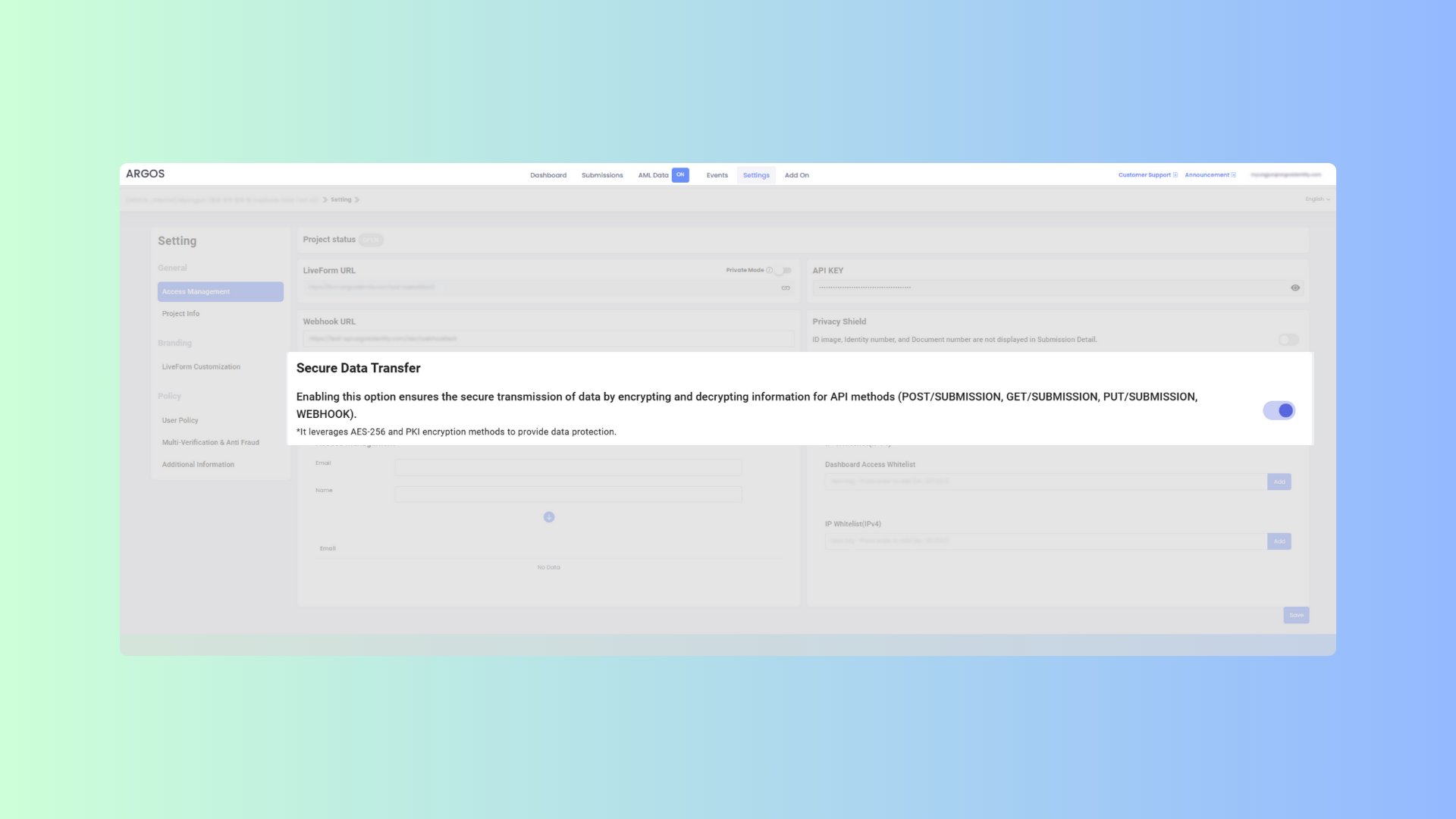
4-2. API 요청 데이터 암호화 (AES-256-ECB)
POST·PATCH 요청 본문의 암호문은 raw base64 문자열로 전달합니다. GET 요청의 암호문은 URL 인코딩한 뒤
data 쿼리 파라미터로 전달합니다.const CryptoJS = require('crypto-js');
function encryptECB(data, apiKey) {
const hashedKey = CryptoJS.SHA256(apiKey);
const key = CryptoJS.lib.WordArray.create(hashedKey.words.slice(0, 8), 32);
const encrypted = CryptoJS.AES.encrypt(JSON.stringify(data), key, {
mode: CryptoJS.mode.ECB
});
return encrypted.ciphertext.toString(CryptoJS.enc.Base64);
}
import javax.crypto.Cipher;
import javax.crypto.spec.SecretKeySpec;
import java.nio.charset.StandardCharsets;
import java.security.MessageDigest;
import java.util.Base64;
import com.google.gson.Gson;
import com.google.gson.JsonObject;

public class Encryptor {
    public static String encryptECB(JsonObject data, String apiKey) throws Exception {
        Gson gson = new Gson();
        String jsonData = gson.toJson(data);

        MessageDigest digest = MessageDigest.getInstance("SHA-256");
        byte[] rawKeyBytes = digest.digest(apiKey.getBytes(StandardCharsets.UTF_8));
        byte[] hashedKey = new byte[32];
        System.arraycopy(rawKeyBytes, 0, hashedKey, 0, 32);
        SecretKeySpec key = new SecretKeySpec(hashedKey, "AES");
        Cipher cipher = Cipher.getInstance("AES/ECB/PKCS5Padding");
        cipher.init(Cipher.ENCRYPT_MODE, key);

        byte[] encryptedBytes = cipher.doFinal(jsonData.getBytes(StandardCharsets.UTF_8));
        return Base64.getEncoder().encodeToString(encryptedBytes);
    }
}
4-3. API 데이터 복호화 (AES-256-ECB)
const CryptoJS = require('crypto-js');

function decryptECB(encryptedData, apiKey) {
    const hashedKey = CryptoJS.SHA256(apiKey);
    const key = CryptoJS.lib.WordArray.create(hashedKey.words.slice(0, 8), 32);
    const cipherParams = CryptoJS.lib.CipherParams.create({
        ciphertext: CryptoJS.enc.Base64.parse(encryptedData)
    });
    const decrypted = CryptoJS.AES.decrypt(cipherParams, key, {
        mode: CryptoJS.mode.ECB
    });
    return JSON.parse(decrypted.toString(CryptoJS.enc.Utf8));
}
import javax.crypto.Cipher;
import javax.crypto.spec.SecretKeySpec;
import java.nio.charset.StandardCharsets;
import java.security.MessageDigest;
import java.util.Base64;
import com.google.gson.Gson;
import com.google.gson.JsonObject;

public class Encryptor {
    public static JsonObject decryptECB(String encryptedData, String apiKey) throws Exception {
        Gson gson = new Gson();
        MessageDigest digest = MessageDigest.getInstance("SHA-256");
        byte[] hashedKey = digest.digest(apiKey.getBytes(StandardCharsets.UTF_8));
        byte[] aesCompatibleKey = new byte[32];
        System.arraycopy(hashedKey, 0, aesCompatibleKey, 0, 32);
        SecretKeySpec key = new SecretKeySpec(aesCompatibleKey, "AES");
        Cipher cipher = Cipher.getInstance("AES/ECB/PKCS5Padding");
        cipher.init(Cipher.DECRYPT_MODE, key);

        byte[] decryptedBytes = cipher.doFinal(Base64.getDecoder().decode(encryptedData));
        String jsonData = new String(decryptedBytes, StandardCharsets.UTF_8);
        return gson.fromJson(jsonData, JsonObject.class);
    }
}
4-4. WEBHOOK 데이터 암호화 (AES-256-CBC)
const CryptoJS = require('crypto-js');

function generateKeyAndIV(apiKey) {
    const hashedKey = CryptoJS.SHA256(apiKey);
    const key = CryptoJS.lib.WordArray.create(hashedKey.words.slice(0, 8), 32);
    const iv = CryptoJS.lib.WordArray.create(hashedKey.words.slice(8, 12), 16);
    return { key, iv };
}

function encryptCBC(data, apiKey) {
    const { key, iv } = generateKeyAndIV(apiKey);
    const encrypted = CryptoJS.AES.encrypt(JSON.stringify(data), key, { iv: iv, mode: CryptoJS.mode.CBC });
    return encrypted.ciphertext.toString(CryptoJS.enc.Base64);
}
import javax.crypto.Cipher;
import javax.crypto.spec.SecretKeySpec;
import javax.crypto.spec.IvParameterSpec;
import java.nio.charset.StandardCharsets;
import java.security.MessageDigest;
import java.util.Base64;
import com.google.gson.Gson;
import com.google.gson.JsonObject;
import java.util.Arrays;

public class Encryptor {
    public static String encryptCBC(JsonObject data, String apiKey) throws Exception {
        String jsonData = new Gson().toJson(data);

        MessageDigest digest = MessageDigest.getInstance("SHA-256");
        byte[] hash = digest.digest(apiKey.getBytes(StandardCharsets.UTF_8));

        byte[] keyBytes = Arrays.copyOf(hash, 32);
        SecretKeySpec key = new SecretKeySpec(keyBytes, "AES");

        byte[] ivBytes = new byte[16];
        Arrays.fill(ivBytes, (byte) 0);
        IvParameterSpec iv = new IvParameterSpec(ivBytes);

        Cipher cipher = Cipher.getInstance("AES/CBC/PKCS5Padding");
        cipher.init(Cipher.ENCRYPT_MODE, key, iv);

        byte[] encryptedBytes = cipher.doFinal(jsonData.getBytes(StandardCharsets.UTF_8));
        return Base64.getEncoder().encodeToString(encryptedBytes);
    }
}
4-5. WEBHOOK 데이터 복호화 (AES-256-CBC)
const CryptoJS = require('crypto-js');

function generateKeyAndIV(apiKey) {
    const hashedKey = CryptoJS.SHA256(apiKey);
    const key = CryptoJS.lib.WordArray.create(hashedKey.words.slice(0, 8), 32);
    const iv = CryptoJS.lib.WordArray.create(hashedKey.words.slice(8, 12), 16);
    return { key, iv };
}

function decryptCBC(encryptedData, apiKey) {
    const { key, iv } = generateKeyAndIV(apiKey);

    // Create cipher params for decryption
    const cipherParams = CryptoJS.lib.CipherParams.create({
        ciphertext: CryptoJS.enc.Base64.parse(encryptedData)
    });

    // Decrypt the data
    const decrypted = CryptoJS.AES.decrypt(cipherParams, key, {
        iv: iv,
        mode: CryptoJS.mode.CBC,
        padding: CryptoJS.pad.Pkcs7
    });

    return JSON.parse(decrypted.toString(CryptoJS.enc.Utf8));
}
import javax.crypto.Cipher;
import javax.crypto.spec.SecretKeySpec;
import javax.crypto.spec.IvParameterSpec;
import java.nio.charset.StandardCharsets;
import java.security.MessageDigest;
import java.util.Base64;
import com.google.gson.Gson;
import com.google.gson.JsonObject;
import java.util.Arrays;

public class Encryptor {
    public static JsonObject decryptCBC(String encryptedData, String apiKey) throws Exception {
        MessageDigest digest = MessageDigest.getInstance("SHA-256");
        byte[] hash = digest.digest(apiKey.getBytes(StandardCharsets.UTF_8));

        byte[] keyBytes = Arrays.copyOf(hash, 32);
        SecretKeySpec key = new SecretKeySpec(keyBytes, "AES");

        byte[] ivBytes = new byte[16];
        Arrays.fill(ivBytes, (byte) 0);
        IvParameterSpec iv = new IvParameterSpec(ivBytes);

        Cipher cipher = Cipher.getInstance("AES/CBC/PKCS5Padding");
        cipher.init(Cipher.DECRYPT_MODE, key, iv);

        byte[] decryptedBytes = cipher.doFinal(Base64.getDecoder().decode(encryptedData));
        String jsonData = new String(decryptedBytes, StandardCharsets.UTF_8);

        return new Gson().fromJson(jsonData, JsonObject.class);
    }
}